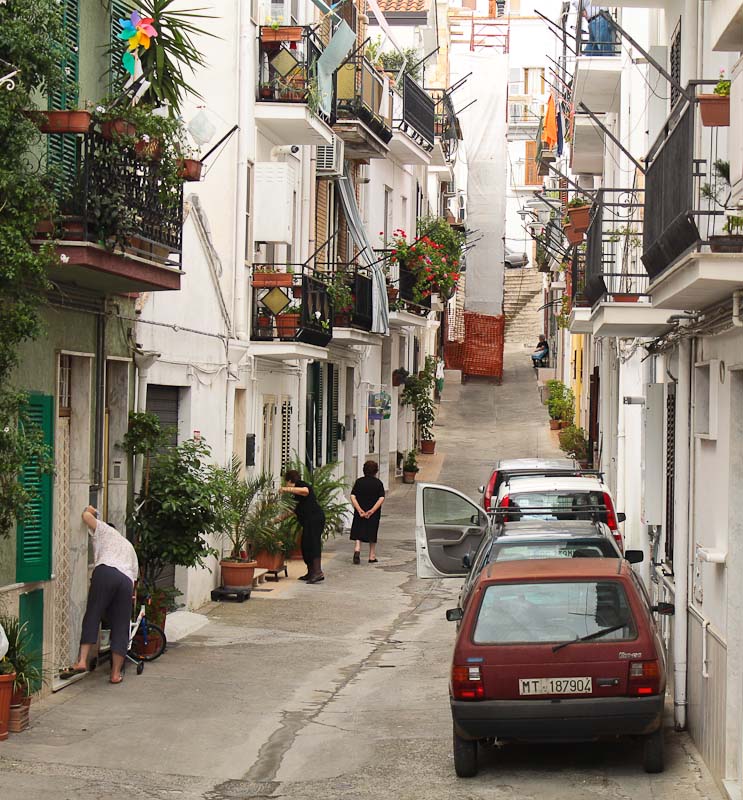
Pisticci
- Santa Maria del Casale
- Corso Margherita and Sant’ Antonio
- Town Hall / Civic Museum
- Terravecchia and Chiesa Madre di San Pietro Paolo
- Dirupo
- Laboratorio Ceramiche Artistiche (Ceramic Workshop)
- L’Incontro Restaurant
- Panorama View including the Dirupo
After lunch, in the mid to late afternoon, plan on driving up to Pisticci. In advance, you should decide whether you want a guided tour which the Torre Fiore staff (www.hoteltorrefiore.com) can help set up, or whether you do the walk on your own. I would recommend a guided tour to assure access to the churches.
This is how I recommend you take a nice exploratory walk in Pisticci, that will take you into the evening.
1. Coming in from the south or north, you enter the Town’s east side, so I would first visit the restored church and abbey of Santa Maria la Sanita del Casale (better known in Pisticci as “U Casal”). The church dates back to 1087, and the statue of the Madonna dates back to the 12th century. Though not as grandiose as the churches and cathedrals in Italy’s cities, like most small town churches, Santa Maria can be appreciated for the architectural beauty that a small town invested into its spiritual place of worship. Built in the Romanesque style, it lords over the Basento valley. As it is only open on Sundays, a guide would be useful here for access. If you are lucky, enquire as to schedule of musical events that they hold intermittently; it creates a special ambiance for such presentations.
2. By car, make your way to the parking garage at Via Giulio Cesare 1 (in Italy the numerical address is after the street name), located at the hairpin on Via Luigi Farini; if you use Google Maps, it is identified as Parcheggio Multipiano; though the parking cost is nominal, make sure you have coins for the exit. Once in the garage, make your way to the top by car, elevator, or stair. Once on top, exit onto the road, turning right, and look for another elevator on the left, that you will take to the top; all of a sudden, BOOM, you are easily in the Centre of Town.
Walk straight and you will come to a dead-end at the Corso Margherita; the main drag for the Passegiata.
As shops respect the afternoon siesta custom and won’t reopen until 5:30ish, take advantage of the opportunity to explore. Go to your left where you will find Piazza Umberto 1, the principal gathering place; if I was looking for any of my uncles, I knew that if they were out, I would find them here, sitting in the shade talking about the day’s news.

The parish church, Sant’ Antonio, on the left of the Piazza, though spartan on the outside, contains a well-preserved inner sanctum that dates back to 1492.
3. Coming out of Sant’ Antonio, go to the right, another quick right, brings you to Piazza dei Caduti (Fallen) where the monument recognizes the local war dead of the two World Wars. On the opposite side of the Piazza is the Town Hall and its Civic Museum. It’s worth a quick look into the courtyard to see the quality of detail.
You may want to consider a pit-stop at Bar Pisticci on the north side of the Piazza, for a coffee (after 12.00 am, don’t ask for a CAPPUCCINO! In Italy they only drink it for breakfast), or a local liqueur, maybe a gelato or a home-made pastry.
Go back to the main square and start your first “Passegiata”; hopefully the stores are open by now. Walking west along the Corso, you will come to the small Piazza Sant’ Antuono, accentuated by a fountain from which provides a steady flow of clean cold water for drinking. The fountain is adorned with four young ladies. Continue walking down the Corso, noticing to the left a few lookouts onto the southern landscape.
You will arrive to Piazza San Rocco.
4. From Piazza San Rocco, find your way up towards Chiesa Madre (literally the mother Church) San Pietro Paolo, starting along Salita Bruno Buozzi. Easy directions; just keep walking up the small hill; with shortest route including a left on Via Raffaele Rogges; always going up. Along this walk you will see remnants of the old walls built into current structures; walls that encircled the Terravecchia (the Old Town).
Throughout southern Italy, as you drive you will see a common thread on the countless hilltop towns and villages; any remaining castles or remnants of castles will be found at the highest point, if possible, edged on three sides by cliffs; the next high point nearest to the castle is the Chiesa Madre, both being within the protected walls of the Old Town. It makes you wonder what was so particularly fearsome that these Towns all had to be so high and so well protected; I’ll save that for another post. San Pietro Paolo dates back to the 13th century; but note to see its well maintained interior is a challenge regarding timing though by now it should be open as my schedule gets you there in the early evening; a guide might be useful.
Wandering the few blocks in the Terravecchia, you will see some of the ancient walls that have now been incorporated into residential buildings. You’ll see the rudimentary remains of the Norman Castle at the western edge of the hilltop, you will see a couple of former gates spanning the narrow roads. Most importantly, you will see the spectacular panorama of the north, west and south. The eerie Calanchi geological formations at the bottom of the mountain are localized to this part of basilicata.

5. The Dirupo on the south side, under the arched walls of Terravecchia is of special note. A landslide in 1688 was significant in its devastation. My unverified take on the damage is that the land probably fell from the level of the Piazza fronting the Chiesa Madre. I deduce that from the narrow public square and road remaining in Terravecchia abutting the Chiesa Madre, in what would have been a more substantial place framed by other buildings, as in other Towns. The Pisticcesi rebuilt using the fallen ground as their new base, and the Dirupo now houses 300 homes from the 17th century.
A personal side note, I always thought that Dirupo meant fallen or tripped; because when I had to be careful not to fall or trip as a child, my mother would say “attient ca t Dirrup” in our dialect. Google translates Dirupo into “precipice or cliff”; I guess the Town fell over the cliff.
6. By this point of your day, all the stores should be open, the Laboratorio Ceramiche Artische (Ceramic Workshop) should be open, a little west of the Chiesa Madre. Anna Maria and Feltirino always have something they are working on, and it’s their ceramics that adorn the walls of Terravecchia.

Their workshop is full of pieces of various sizes that might draw your interest; look at the quality of their fragile high gloss flowers; their collectible representation of the white-washed facades of Pisticci’s houses are an easy nostalgic item to bring back home. If you ask Feltirino, he will be thrilled to tour you through their small museum showcasing handiwork by other Pisticcesi artisans.
7. Finish your day with dinner at L’Incontro restaurant. Beniamino is a mainstay in the Pisticci commercial association. As far back as I can remember, his food comes the closest to what my mother prepared for us. If you are into sharing, you should split up his antipasto offerings; the bigger the group, the more to choose from. You want to be careful, because sometimes you are so full, you don’t get to the main dishes. Their pizza is great, and you should be aware that in most of small town southern Italy, real fresh pizza is only served at night, because they only fire-up the pizza ovens once a day.
8. As you leave L’incontro, going back up the Corso, make sure you look to your right through the lookouts, to see the Dirupo at night. The square you will see is Piazza La Salsa, renamed to Piazza Johnny Lombardi. The renaming was to honour a multilingual media giant from Toronto, Canada whose roots were Pisticcesi, and whose media consistently reminded viewers of that connection. Though I was at least one generation younger, I was fortunate to have known this man, and recognized his importance to Italo-Canadian immigrants, and subsequently how he help other nations’ immigrants adapt to Canada.
If its a busy night, you will see many people on the top half of the Corso, walking arm-in-arm, in conversation, going “annanz e jeret in du cors” (back and forth in the Corso). They may even eye these strangers (that you are), just smile back and give them a friendly “Buona Sera”. When you are ready to go back to the hotel, go left on the road in front of the “Tutto Scuola” store, you’ll see the elevator at the dead end.


EXPLORING AROUND PISTICCI
- Museo Essenza Lucano
- Calanchi
- Marconia | Tinchi
- Castello di San Basilio
- Sailing


Leave a Reply