Background
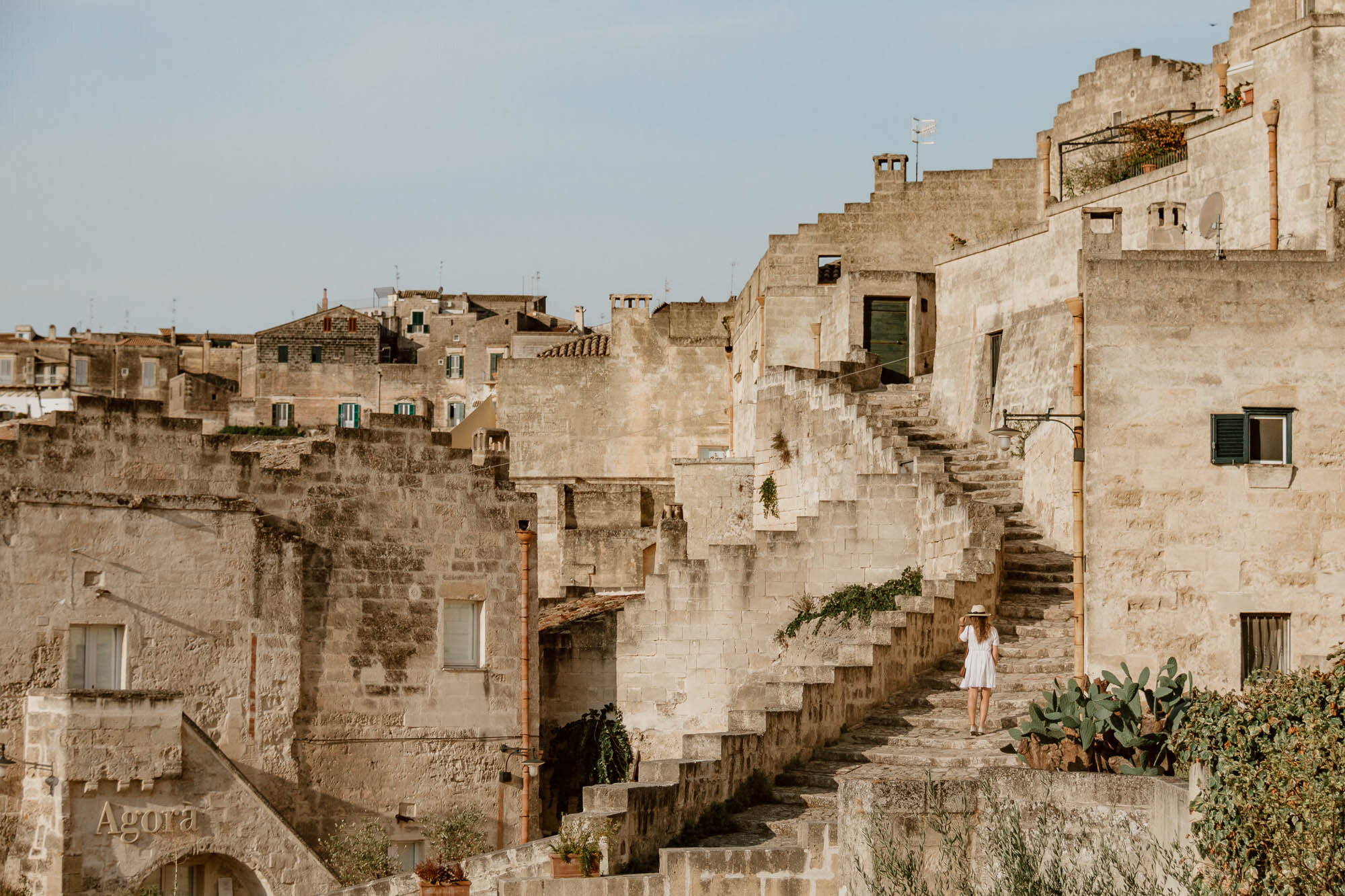
The internationally reknown “Sassi” of Matera is an unforgettable visit; in Basilicata it is a “must see”. Once you get there and start wandering the relics of the old town, your first thought is likely to be “how could people live here, like this?”
Known as “la Città Sotterranea” (the Subterranean City), Matera is one of the oldest continuously inhabited cities in the world, having been inhabited since the 10th millennium BC, and inhabited by the Romans in the 3rd century BC.. Its historical center , the “Sassi”, along with the Park of the Rupestrian Churches, has been designated a World Heritage Site by UNESCO since 1993, and in 2019, Matera was declared the Italian host of European Capital of Culture.


As a youngster, when I visited this City, the devastation of the abandoned cliffside Sassi neighborhoods, left a lasting impression on me. We were allowed to wander through the old town, built into the western cliffs over the Gravina River, with steep winding paths, no roads, sewage running down the pathways, and water collected through cisterns. By the 1950’s the government of Italy decided to deal with this national embarrassment, and used force to relocate most of the teaming population of the Sassi to areas of the developing drab modern city. We visited only to see what was left of the Sassi, because the new town continued to be a poor one, until the late 1980’s.
One thing we did back then, which continues now, is visiting staged homes as they once were. Writings about Matera’s Sassi talks about how people lived in caves. But when you see the cliffside dwellings from the outside, they look like any other southern Italian town residential facade, except steeper. Many of them are really little more than caverns, and in some parts of the Sassi a street lies on top of another group of dwellings. Look across the Gravina gorge to the east side, and you will see the open caves that were inhabited back to the Palaeolithic ages. On the Sassi western edge of the Gravina, for defensive reasons, as the population grew, people stayed in the caves, but innovatively they would dig out the soft limestone cave to enlarge their space, and use the stone to complete the front facade of their home; and basically had only one part of their home exposed to the elements.


This was a major plus when it came to controlling temperature, but a huge negative in that there was hardly any ventilation; if you tour one of these staged homes you will see how very large families lived together with their animals, creating what must have been an unforgiving odour.
In hindsight, fortuitously, the government had not destroyed the old Sassi when they were abandoned. Eventually, the government at all levels, developed a strategy to bring the Sassi back to life. The tourists continued to come, as my family did, to visit what had been considered an embarrassment, but the town on top was starting to thrive as the quality of life improved. Interesting to realize that there were many palazzo’s along the top of the sassi, a contrast that you still see today as you explore; the higher up you got in the sassi the more affluent the inhabitants were. You can really see that in the structures around the hilltop Cathedral, the Ridola, and the Piazza del Sedile.
The first thing that had to be done to convert this uninhabitable poor district, was to give the Sassi the needed infrastructure; the sewers, the piped water, and electricity. Then a strategy had to be developed that brought businesses and inhabitants back in. The strategy relied on an iterative process that increased tourism, which allowed the upper town to prosper; restaurants and hotels in the dug out caves have become very chic. Iteratively, the upper town expanded with quality shops, and its own restaurants, cafes, gelato shops. The present local administration, continues to be more tourism-oriented, and it has promoted the regeneration of the Sassi with the aid of the Italian government, UNESCO, and Hollywood. Today there are many thriving businesses, pubs, and hotels down in the Sassi, and on top; the changes have been steady and Matera is prospering.
Like much of Italy, Matera has been in a state of flux as to who ruled it; which can be seen in the style of buildings from each era, whether they be Lombards, monastic, Byzantine, German, Normans, Aragonese, French.
Cattedrale di Matera


Piazza del Sedile




Leave a Reply